


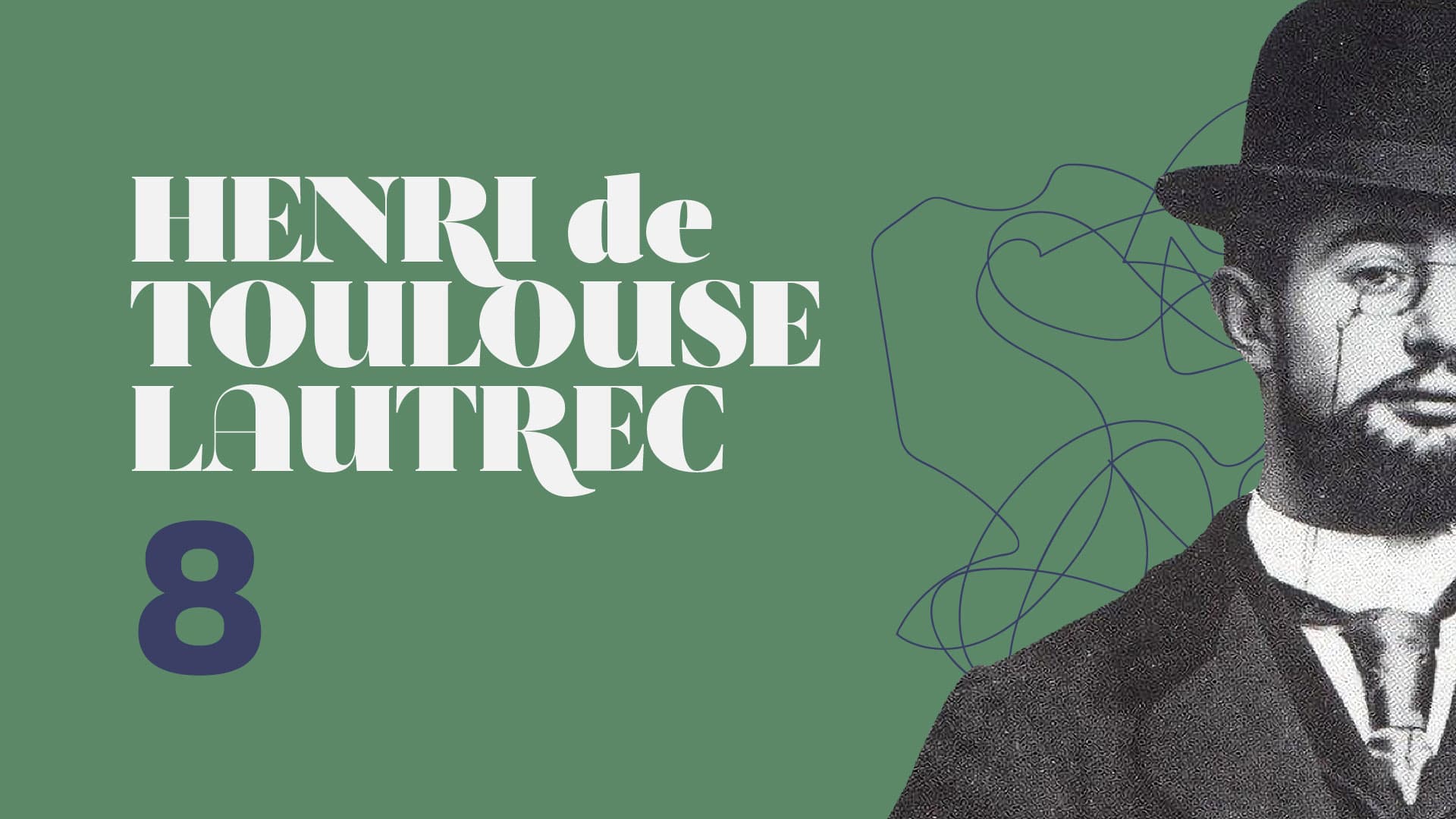
Toulouse-Lautrec vs. the bourgeoisie
We have already emphasized Lautrec's sympathy for the outcastsof society, the marginalized people who had built an ecosystem of their own in Montmartre. The painter's social status would have easily allowed him, despite his physical stature, to look down on that world; and yet Toulouse-Lautrec always demonstrated a profound sensitivity to and understanding of the psychology and character of the subjects of his work. His distaste was more often directed at the bourgeois people who visited that world of the marginalized for a fleeting, voyeuristic thrill, or to exploit the human beings that comprised it. Toulouse-Lautrec was also anti-bourgeois because he was, first and foremost, an aristocrat: a count of one of the oldest and most prestigious noble families in France. For that very reason, he had a keen sense of the distinctions between social classes, although he did not discriminate against the lower classes.In his paintings, the patrons who chose a cafè concert over one of the more fashionable cafes along the city's central boulevards are often depicted in a grotesque manner, with deformed features and a physical baseness reflecting a moral bankruptcy much greater than that of any prostitute or dancer. And if at times he turned his mocking gaze on the characters that populated the nightlife, he did so in the same way he turned that gaze on himself:Lautrec laughed at the characters he loved to surround himself with, and so also laughed at himself. Lautrec's time period was also one of a renaissance in satire, so his collaboration with the magazine Le Rire - "The Laugh" in French - was only natural. Le Rire was a satirical magazine first published in October of 1894. It immediately landed Henri as an illustrator, as several works in this exhibition demonstrate. With his usual skilled synthesis, quick brushstrokes, and accessories that become emblematic of the artists wearing them (think of the black gloves of singer Yvette Guibert, or the famous red scarf of Aristide Bruant), Lautrec uses playful irony to show us a new, sincere world. Speaking of Aristide Bruant, the subject of many of Toulouse-Lautrec's posters: he was a singer and undisputed star of the Montmartre scene, as well as a hilarious cabaret comedian. It is significant here to recall one of his most famous shows. In it, just like in many of today's fashionable clubs, he insulted the bourgeois audience attending the event, who always returned a second and third time to hear all about how they were fat, old, and incapable of satisfying their better halves. Lautrec fully grasped the thin line Bruant walked, depicting him in another work also on display in this exhibit in the most irreverent way possible: turning his back on his audience.
Toulouse-Lautrec vs. the bourgeoisie
--:--
--:--